What will a new boiler cost Doncaster homeowners? It depends on your house as much as on the boiler. Six things move it: whether the type of boiler changes, where it sits, where the flue and the condensate pipe can go, how dirty the water in your radiators is, whether the gas pipe is big enough, and which boiler and controls suit the house. None of those can be seen from a phone call, which is why Mick comes out and looks before he gives you a figure.
Below is each of the six in plain English, then what happens on the visit and how to compare two quotes so you know they are for the same job.
Why can a new boiler cost Doncaster households more than the house next door?
The boiler is only part of the bill. The work around it is the part that changes most from house to house. Two neighbours buying the same model can get very different quotes because one is a straight swap on the same wall and the other means taking tanks out of the loft, moving the boiler to a different room and running a new gas pipe to it.
- The type of boiler: keeping the same kind is the simplest job; changing from one kind to another is not.
- The position: the same spot, or somewhere new.
- The flue and the condensate pipe: where each can legally and sensibly come out.
- The state of the system: clean water or years of sludge.
- The gas supply: whether the pipe from the meter can feed the new boiler.
- The boiler and controls: the right size and the right extras, not the biggest.
Is a like-for-like swap cheaper than changing the type of boiler?
Usually, yes. If you have a combi now and a combi suits the house, the new one goes where the old one was, on the same pipes, and most of the work is in the boiler cupboard.
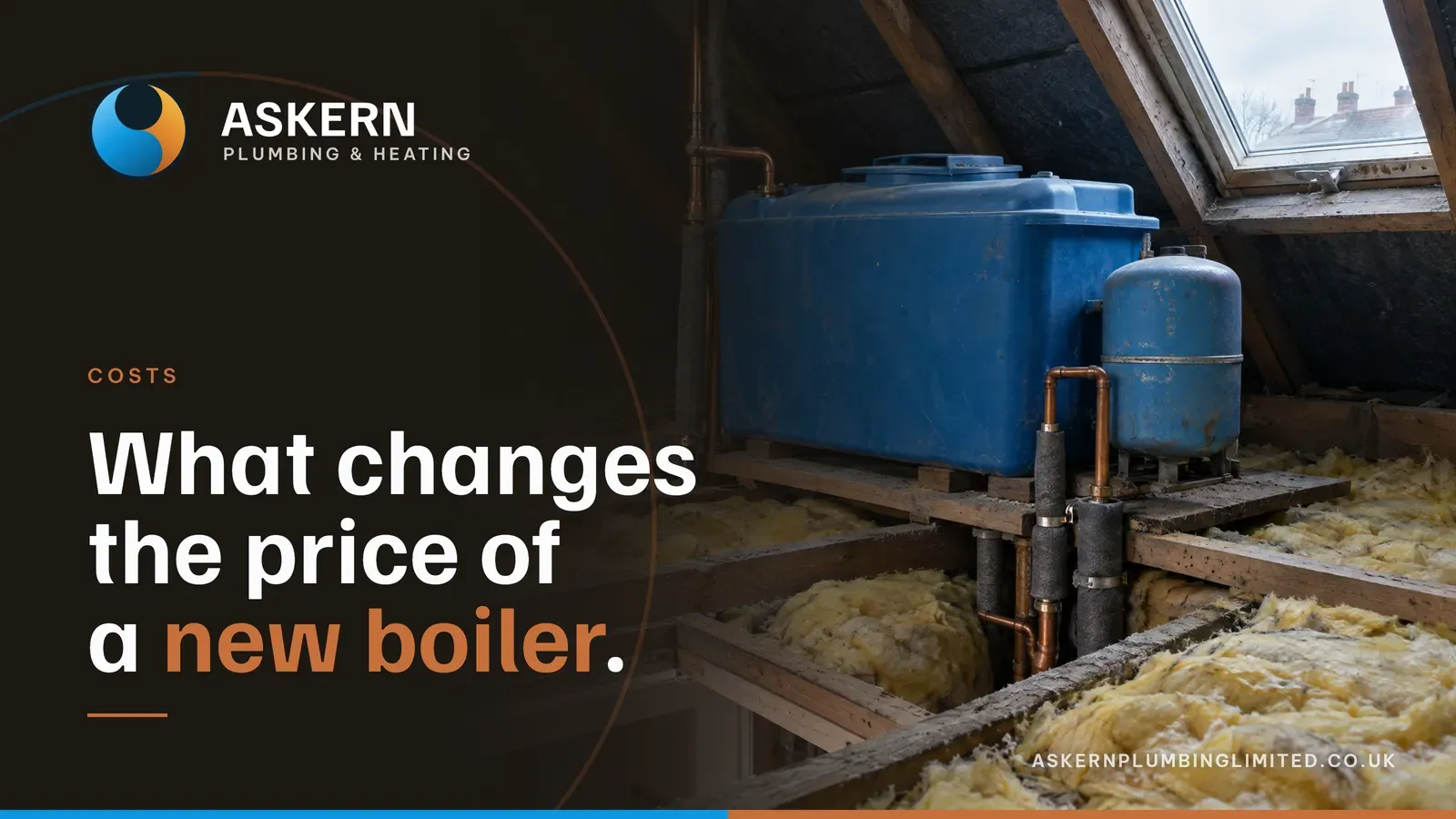
Changing type is where the job grows. One change that adds a lot of work is going from a regular boiler, with a hot water cylinder in the airing cupboard and tanks in the loft, to a combi. That means draining down, taking the cylinder out, taking the cold water tank and the small feed tank out of the loft, capping or rerouting the pipes that served them, and connecting the new boiler straight to the mains. You gain a cupboard and an empty loft space, but it is several jobs rolled into one.
It also depends on your water supply. A combi heats water as you use it, straight off the mains, so it can only give you what the mains brings in. Worcester Bosch's guidance for its combis says the incoming main should be checked before or at installation, to make sure it can feed the boiler while other cold taps are in use, and it warns that pressure and flow are not the same thing: a house can have decent pressure and still a poor flow, depending on the size, type and condition of the pipe coming in. If the flow is weak, cold water can be pinched from the boiler when someone runs a tap elsewhere. That needs testing at the house, not guessing at, and on some houses a combi may not suit.
Going the other way, from a combi to a system boiler with a cylinder, is less common but just as much work, because a cylinder has to go in and be piped up. Combi, system and regular boilers are each explained in plain English on our boiler installation page.
Why does it matter where the boiler goes and where the flue comes out?
Every new boiler has a flue, the pipe that takes the fumes outside, and where it can come out is not up to you or the installer alone. It has to clear windows, doors, the eaves and your neighbour's side, so a flue that was fine on the old boiler is not always in the right place for the new one.
Keeping the boiler where it is usually keeps the flue simple. Moving it, say from the kitchen into a bedroom cupboard or the loft, means a new flue route, new heating pipes, a new gas pipe and a new condensate pipe, plus making good where the old one was. It can be well worth doing, and it is your house, but it is a different job from a swap and it is priced as one.
Flats and homes with a hidden flue
Some flats and newer homes have a flue that runs inside a ceiling or a boxed-in space before it reaches the outside wall. HSE's safety bulletin on flues in voids explains that these were mostly fitted in flats and apartments built since about 2000. Since the end of 2012, an engineer has to be able to see that kind of flue to check it, which normally means inspection hatches. Without a way to check it, the engineer will advise that the system is "at risk" and, with your permission, turn off the gas to the boiler. If your boiler's flue disappears into the ceiling, mention it when you ring: hatches, or the alternative HSE describes in some cases, may need to be part of the job.
What is the small white pipe, and why can it add work?
A modern gas boiler condenses: it pulls extra heat out of its fumes, and that leaves water behind, which runs away through a plastic condensate pipe to a drain. Older non-condensing boilers did not need one, so swapping an old boiler for a new one often means running this pipe for the first time.
The easy route is inside, into a waste pipe under the sink. Where it has to go outside, it can freeze in a cold snap, and a frozen condensate pipe stops the boiler. Worcester Bosch's own guidance shows how seriously makers take this: for its boilers without a frost-protection kit, it says an outside run must be kept to three metres at most and insulated, and that a wider 32mm pipe may be worthwhile. Getting that route right takes a little longer on the day and saves a breakdown in January.
Does the water in my radiators change the price?
It can, a lot. When a boiler is replaced, the heating system has to be cleaned and flushed before the new one is connected, with an inhibitor added afterwards. Where that rule comes from is set out with the others on our installation page. How long the cleaning takes depends on what is in the pipes.
On a system that has been looked after, it is a routine part of the day. On one that has run for years without inhibitor, the water can be black with sludge, and putting a new boiler on that without a proper clean just moves the problem into the new heat exchanger. The signs you might already have noticed are radiators that are warm at the top and cold at the bottom, dark water when you bleed one, or a system that takes a long time to warm the house. Mention any of them when you ring.
If the pressure gauge keeps dropping as well, say so: a leak somewhere on the system is worth finding and fixing first, so the new boiler is not topping up a hidden drip from day one.
Is my gas pipe big enough for a new boiler?
Whatever boiler goes in has to get enough gas when it is working its hardest, and a combi making hot water is one of the hungriest things in a house. The pipe from your gas meter to the boiler has to be big enough to carry that without the pressure dropping too far. On many swaps the existing pipe is fine. On some, especially where a combi replaces a smaller boiler or the pipe run is long, a section has to be replaced with a wider one.
This is checked with a gauge, not by eye. It is one of the reasons a price given before anyone has looked can change once the work starts.
What do the boiler and its controls add?
The boiler itself matters, but bigger is not better. A boiler should be sized to the house and the hot water it has to make. One that is far too powerful for the house costs more to buy and can run less efficiently, switching on and off more than it should.
Controls are part of it too. The rules ask for basic time and temperature control with any new boiler, and one extra energy-saving measure on top with a new combi, such as a smart thermostat with the right features. If you already have good controls, they may be kept; if you want a smart thermostat anyway, Mick fits those too.
Then there is the warranty, which is set by the manufacturer and differs between models. Check the maker's terms: many make a yearly boiler service a condition of the warranty, so it is worth weighing the two together.
Why do we look before we price?
Because every one of the six things above is something you find in the house, not on a price list. A figure given down the phone has to assume the easy version of each, and if any of them turns out harder, the price moves on the day. We would rather tell you once, in writing, after seeing it.
When Mick comes out, he looks at the boiler and its flue, at the pipework and at the pressure, and there is no charge for the visit. After that the price comes to you in writing, for that job and nothing vaguer. You do not have to decide there and then.
To help him before he arrives, send a photo of the old boiler and where its flue comes out to 07734 694 463 on WhatsApp, and say roughly where you would like the new one to go.
How do you compare two boiler quotes fairly?
Put them side by side and check they cover the same work. The rules every installation has to meet, from cleaning the system to the paperwork, are listed on our boiler installation page, so tick those off first. Then look for the parts of the job that change from house to house, because those are the ones a quote can leave out:
- Does it cover moving or extending the flue, if the new boiler needs it?
- Does it include running the condensate pipe, and insulating it if it has to go outside?
- Does it allow for a wider gas pipe from the meter, or will that be extra if it turns out to be needed?
- If you are changing to a combi, does it include taking out the cylinder and the loft tanks and capping the old pipes?
- Is the person doing the gas work on the Gas Safe Register? You can ask to see their Gas Safe ID card.
A quote that answers all of those plainly is easier to trust than a cheaper one that leaves them open.
Ready for a price on your new boiler?
Ring 07734 694 463 any weekday between 8am and 5pm and you will speak to Mick, the Gas Safe registered engineer who will come and look. Checkatrade has listed us since 2016: 350 reviews, a score of 10, and the £1,000 guarantee that membership puts behind our work.
From Askern we fit new boilers across Doncaster and South Yorkshire. For boiler repairs, and everything else on the gas side, start at heating and gas; for leaks, taps and blockages, see plumbing and repairs.