A boiler losing pressure is losing water from a sealed system, and there are five usual reasons: a radiator has just been bled, a pipe or radiator valve is leaking, the boiler is leaking inside, the pressure relief valve is letting water out, or the expansion vessel has lost its charge. The first two you can check yourself. The other three need a Gas Safe registered engineer.
Below is how to tell them apart from the outside, using nothing more than the gauge on the front of the boiler, a dry tissue and a look at the pipe on your outside wall. If you are in Doncaster or nearby and would rather someone else did the looking, Mick's number is 07734 694 463.
What is a normal boiler pressure reading?
Most combi and system boilers have a pressure gauge or a digital pressure reading on the front. Read it with the heating off and the radiators cold, because water expands as it warms and the number climbs.
- Cold: Vaillant puts a normal reading with the system off at 1 to 1.5 bar.
- Hot: with the heating running, Vaillant says the gauge usually sits between 1 and 2 bar.
- Too low: Vaillant's UK advice is that a reading below one bar means the boiler has lost pressure.
Your own boiler's manual has the figure for your model, and it wins over any general guide, this one included. Older houses with a tank in the loft and a hot water cylinder often run an open vented system with no gauge at all, and none of this applies to them.
What are the five causes of a boiler losing pressure?
A sealed heating system is a closed loop. Water only leaves it if something lets it out, so every one of these causes comes down to where the water is going.
1. You have just bled a radiator
This is one of the most common, and the only one that is not a fault. When you bleed a radiator, the air that comes out was taking up space in the system, and so does the splash of water that follows it. Both Vaillant and British Gas list bleeding as a reason the pressure falls. If the gauge dropped on the day you bled the radiators and has held steady since, top it up once and forget about it.
2. A slow leak on the pipes or radiator valves
Vaillant says pipework and radiator circuits can corrode or loosen over the years until water starts to escape, usually at a radiator valve. The leak is often too slow to see as a drip. Look instead for:
- damp or green and white crusting around radiator valves and their nuts
- flaking paint or brown marks on skirting boards and pipe boxing
- stains on a ceiling below a radiator or under a bathroom
- a towel rail or radiator with rust spots along the bottom edge
A cold pipe may sweat and look like a leak. Vaillant's tip is to wipe the pipe dry and leave a plate under it, so you can see whether drops are really forming. Worcester Bosch adds a point worth remembering in a house with pipes under the floorboards: the leak may be somewhere you cannot see at all.
3. A leak inside the boiler
When nothing on the radiators or pipes is wet, the water may be leaving inside the boiler itself. Vaillant says parts inside can corrode or loosen with age, and the sign is usually a drip from the underside of the boiler. Do not take the front casing off to look. Behind it is the gas valve and the burner, and that is Gas Safe work only.
4. The pressure relief valve is letting water out
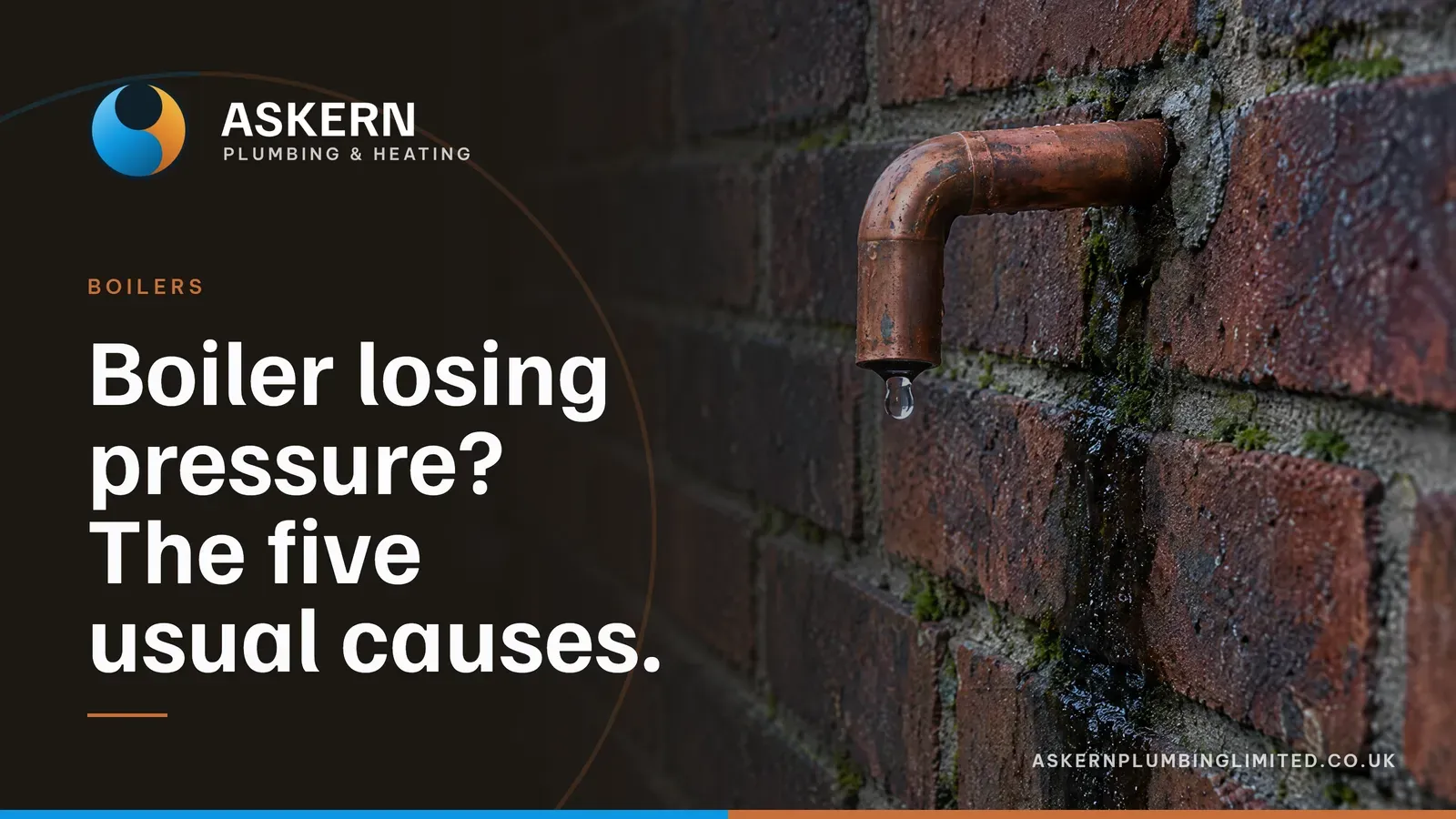
Every sealed boiler has a pressure relief valve. Its job is to let water out if the pressure ever climbs too high, through a small pipe that usually runs from the boiler to an outside wall and ends outside. Worcester Bosch's advice is to check the end of that pipe: if it is wet, the valve may be faulty.
Go and look at it after the heating has been on for a while. A pipe that should be dry with a damp end, a drip, or a stain on the wall below it tells you where your water is going. If you cannot find the end of the pipe, say so when you ring.
5. The expansion vessel has lost its charge
Inside or next to the boiler is a small tank called the expansion vessel. Vaillant describes its job as absorbing the extra pressure from the water as it heats. When it stops doing that job, the water has nowhere to expand into.
The pattern to watch for is a gauge that swings. It reads normal or a bit low when cold, climbs well above 2 bar once the heating has been running, and is lower again the next morning. If the pressure climbs high enough, the relief valve can open and let water out, which is why a wet outside pipe and a swinging gauge can go together. Vaillant's advice is to call a qualified engineer if you suspect an internal part is at fault.
Which of these can you sort yourself?
- Bleeding: yes. Top up the pressure and you are done.
- A leak you can see: you can find it, and catch it with a bowl or towel. Vaillant's advice is not to repair loose or broken pipework unless you are trained. A dripping radiator valve or joint is a plumbing job, and our plumbing repairs cover it.
- A leak inside the boiler, the relief valve or the expansion vessel: no. Each of these is a fault in or around the boiler, and the parts inside the casing are Gas Safe work only. At Askern Plumbing that is Mick.
How do I top up the pressure safely?
Topping up is something most owners can do, and your boiler's manual shows the exact steps for your model. British Gas says to check the manufacturer's booklet first, switch the boiler off and let it cool before you start.
- Find the filling point. On most combi boilers it is a filling loop: a short silver braided hose with a small tap or lever at one or both ends, under the boiler. Some Worcester Bosch models use an internal filling key instead, as British Gas notes.
- Note what the gauge says while the heating is off and the radiators are cold.
- Open the taps slowly. You will hear water running in. Watch the needle the whole time.
- Close the taps as soon as it reaches the figure your manual gives, often 1 to 1.5 bar.
- Make sure both taps are fully shut, switch the boiler back on and reset it if it asks.
Overfilling is the common mistake. Push it too high and the relief valve may open, which adds a new problem to the one you had. If you are not sure where the filling point is, or the taps will not turn, stop and ring rather than force anything.
How often is too often to top up?
Topping up once after bleeding the radiators is normal. Having to do it again a few days or weeks later is not, however tempting it is to keep doing it. Each top-up lets in fresh water that the system then has to lose again, and it hides a leak that is quietly working on a valve, a floorboard or a ceiling.
A simple record helps. Write down the reading cold in the morning and again with the heating on, for three or four days, along with the date of any top-up. A slow, steady fall points to a leak. A big daily swing points to the expansion vessel. That note is worth more to an engineer than any description of the boiler.
What should I tell Mick when I ring?
Have these ready and the call will be short and useful:
- the cold and hot readings, and how fast it falls
- when you last topped up, and whether anyone has bled the radiators recently
- whether the pipe on the outside wall is wet, dry or impossible to see
- any damp patches, drips or ceiling stains you found
- whether the boiler has stopped, and any code it shows
A photo helps too. WhatsApp a picture of the gauge and one of the outside pipe to 07734 694 463, which takes calls and messages alike. Once it is fixed, our boiler service page covers the yearly check that catches some of these early.
Can low pressure be dangerous?
Low pressure is a water problem, not a gas leak. The danger is in what people sometimes do about it, such as taking the casing off. If you smell gas, do not touch the boiler. Open the doors and windows, shut off the gas supply at the meter, and stay away from light switches and naked flames. Then ring the National Gas Emergency Service free on 0800 111 999, day or night.
Who fixes a boiler that keeps losing pressure near Doncaster?
We are Askern Plumbing & Heating, a three-man firm based on Flockton Lane in Askern, with Mick as our Gas Safe registered engineer. On Checkatrade, where we have been listed since 2016, our 350 reviews add up to ten out of ten. We work across Askern, Doncaster and the villages between, and our boiler repair page explains how a call-out works. If it turns out the boiler is worn out, our new boilers page covers what a replacement involves.
The phone is answered from 8am to 5pm on weekdays: 07734 694 463. Estimates are free, and we would rather look than guess, so we will not put a price on a repair until we have seen the boiler.